Mike’s interview with Nic Jones, 18-Mar-1997

Nic Jones

by Michael Raven

In the late 1970s, at the height of the revival, Nic Jones was probably the most sought after solo performer on the British folk scene. He had an armoury of guitar techniques, a lyrical style of singing, and a varied choice of mostly traditional material that he made modern and relevant to today by his arrangements.

Image of Mike with Nic Jones, 18-March-1997
Mike with Nic Jones, 18-March-1997

Nic was born at Orpington, in Kent, on the 9th of January, 1947. His father owned a newsagent’s shop. When Nic was two years of age the family moved to Shenfield Crescent, Brentwood, Essex and ran newsagent’s shops first at Gidea Park and then at Chelmsford. Later, Nic attended Sir Anthony Brown’s School for Boys at Brentwood. This was a public school. A year below Nic was Noel Edmunds, the disc jockey and TV presenter. Another old boy was Jack Straw, who had yet to develop his taste for denying old age pensioners the right to keep pets in council houses. (Do you remember that London borough scandal, when hundreds of cats and dogs were put down?)

Anyway, Nic did not like public schools in general, and his in particular. At the age of about 17 he left and did a variety of jobs – petrol pump attendant, insurance office clerk and lifeguard at the local swimming pool. He had taught himself to play the guitar and learned to read music.

Nigel Patterson, a school friend of Nic’s, was in a group called The Halliard. This consisted of Nigel, Dave Moran and guitarist Geoff Harris. Nigel and Dave wanted to go professional but Geoff did not, so he left and Nic replaced him. The Halliard were a popular band and played all over the country. I was in the Black Country Three at the time and we used to swop clubs with The Halliard. Nic ran a club in Brentford, Dave Moran had one in Chelmsford, and they had another at Braintree.

The Halliard lasted for about three years. It broke up in 1968 when the members started to develop different interests – Dave Moran wanted to do social work, for example. They had made two recordings for Saga: The Irish in Me, which they hated but which got high in the Spanish charts; and one of their broadside songs, which was never released, ostensibly because they would not sign away their publishing rights. Some of their club songs were recorded by my father in the lounge of our house in Wolverhampton. These ‘field recordings’ were put on to an LP, The Halliard : Jon Raven, which they sold on their farewell tour.

With the demise of The Halliard Nic went solo and carved for himself a glittering career. He met and married Julia and lived in Chelmsford. They lived here until 1974 when they moved to Doddington, near March, in Cambridgeshire. Nic cut a striking figure. He was tall, athletically lean and handsome with bushy eyebrows and for a time he sported a Mexican style moustache. I once did a concert with Nic in Stafford and we had a drink in the pub beforehand. I also had a Mexican moustache and I remember thinking then that we looked a right pair of renegades out on the town and looking for trouble.

Nic did short tours, with a few days at home in between, and tried to avoid one-off bookings. He was a young man, in good health and “it was a good life.” He made four solo LPs for Bill and Helen Leader’s Trailer label: Ballads and Songs, Nic Jones, Noah’s Ark Trap, and From a Devil to a Stranger; and one for Topic, namely Penguin Eggs. Nic was also in the very short-lived Bandoggs (‘wild dogs’), which consisted of Nic, Tony Rose, and Pete and Chris Coe. In 1978 they made one LP for Trailer, did a two week tour and disbanded.

Nic was a quick worker, both in making arrangements and in recording. If a song hadn’t worked after three takes he abandoned it. His recordings were always ‘honest’. That is, he sang and played as live. He did not multi-track – putting the guitar part down and then singing after on another track – which many of his contemporaries were doing. The only time he did this was to add a fiddle part, and that it is quite permissible.

Nic did some radio work, including the John Peel show, and was also in demand as a session musician. My brother, Jon, used him on several LPs – Songs of a Changing World, on which he also sang solo, albeit when he was in his over-ornamented Delaney’s Donkey braying phase; English Sporting Ballads, accompanying Martin Wyndham Read, and Andy’s Gone, on which he again accompanied Martin. He also provided guitar accompaniments for Jon on an LP called English Country Songs, but the master tape was accidentally erased at the studio before the record was made. Others he worked with included Maddy Prior and June Tabor (on the Silly Sisters LP), and Barbara Dixon; and he has fond memories of doing a TV soup advert with Peter Bellamy in Norwich.

Nic was very professional in his work. He never drank alcohol whilst performing and had given up smoking at about the age of 20, when he married Julia. He has always had strong opinions and did not suffer fools gladly. Once, up north somewhere, he had a noisy audience, so he turned his back to them and played to the wall until the chattering subsided.

Of his contemporaries Nic particularly liked the guitar playing of Bert Jansch and the singing of Shirley Collins. He thought Shirley was the bees knees, “because she really felt what she was singing about”. However he has always been receptive to all kinds of music, from Ry Cooder (a particular favourite to this day) and Lou Reed to African traditional. “And Ray Charles,” he adds; “I learned a lot from Ray Charles.” He liked Archie Fisher and greatly admired Alex Campbell. “He was superb. He always did a good night for us at the club.” Nic has written some nine songs but has only recorded three of them. The others he threw away.

By 1982 Nic was in his prime. Then, in February of that year he was driving home having played at Glossop Folk Club. He was tired and, on a bend in the road between Peterborough and March, he ran into a fully loaded lorry which had pulled out of the Wittlesea Brickworks. He was taken to hospital and stayed there for eight months, being released in September of that year.

He was in a very bad way indeed. Both legs, both arms and both jaws were broken, his brain was badly damaged and his right side co-ordination was gone. For weeks on end he had his head in a cage, a tube down his throat, and was covered in plaster. He could not move anything and was unable to speak. Julia kept all but a few very close friends away, and these were subjected to watching him trying to wrench off the cage which had been screwed into his skull. One poor chap almost went into hysterics when Nic suddenly pulled out his own tracheotomy tube.

He did not recognise people, even his own mother, and went though a period when he thought every visitor was ‘out to get him’. The only memories he has today are of the time they came to remove the plaster from his right leg – he thought they were going to cut his leg off – and of the nurses. Not the blonde ones, just the dark-haired nurses. He often mentions these today, as much to tease Julia as anything. But when pushed he admits that his memory of them is mostly really from what others have told about his infatuation. “Anyway,” I said, “it didn’t affect your libido then? “ Oh no!” he laughs, “I was a dirty young man then and I’m a dirty old man now.”

Today, 15 years on, Nic is very philosophical about the whole thing. “If I hadn’t hit that lorry I might have gone a mile down the road and had an even worse accident; I could have been killed.” He just feels lucky to be alive. There is no bitterness, and except for a list to starboard you would not think anything was physically amiss. He won’t be running any marathons, but mentally he is a better adjusted man than most of us, and if we were all as easy-going and grinned as much as he does the world would be a better place. The only real cloud in his sunny sky is his frustration at not being able to play the guitar as well as he used to. This is primarily because of a co-ordination problem in the right hand. He practises a lot and still gets much pleasure out of playing, but will probably never perform in public again.

Nic is aware that with modern studio techniques he could multi-track and ‘fake it’, but he is not interested in such mallarky. I told him of the lengths some groups and solo artistes go to these days – sending tapes by post to other musicians for them to make their contribution at leisure, often slowing the tape down and other tricks. He was horrified. At being told that it was common for people like David Bowie and UB40 to mime at live concerts he was aghast. Then up jumps Julia: “There you are Nic, that’s what we’ll do. Put you on at Cambridge. I’ll be round the back pulling the strings. Nobody would ever know!”

I mentioned that recently, an up and coming young female fiddler/singer recorded her first ‘solo’ CD with the assistance of 11 guest musicians. I mean, that simply is not a solo recording. One or two guests to add a little variety is one thing, but 11? Her record company can’t have much confidence in her solo abilities. If so why bother making a solo album. Join a band and be done with it. Us old men nod our heads in bewilderment.

But to return to Nic. He only wants to play better for himself, not so that he can go out playing live again. He enjoys his present, easy life. The fiddle has been dropped altogether. He had a nice, light touch, but he no longer has the flexibility in his wrists to be able to play satisfactorily.

I asked him what kind of music he would perform if all was well and he was on the road again. His answer was that he would only do things that really meant something to him, that he could sing with conviction, that had a relevance to both him and the audience. Folksongs as such are of little interest. It is the individual piece that matters. He is very disparaging about many of the songs he used to sing, “because they are not relevant to today”. This is something of a hobby-horse. Julia thinks that this dismissal of traditional material is partly because subconsciously it has a painful association. It belonged to another life and that is done and gone with now.

Nic talks about writing his own songs, he always is, though  never actually gets round to doing it. He really is an idle so and so, but then he always was. Nic can be quite loquacious, but ask him to write some sleeve notes for one of his recordings, for example, and you are lucky to get a dozen words. So, I suggested he write poems. I’m into that myself these days, and I tell him that many of the best ones are very short. “Behind the Odeon”, he says. There you are Nic your first poem, and its in print. You are now a published poet!

Today, Nic lives the life of a kept man in a pleasant suburb of York near the university. About Julia he says: “She has really looked after me. Most women would have left me by now. She’s amazing. She’s a great girl. I find it difficult to say how magnificent she has been. Its crazy, I get all embarrassed at saying how wonderful she has been. She’s a solid person.”

Julia works for a charity called York Homestart, a group of volunteers who support families going through a rough patch. She and Nic have two children: Joe who plays the guitar, sings and writes songs and who has just left to live in Newcastle; and Helen, who has just started at the University of Leeds. Then there is Harry, an adorable silver-grey bearded collie whom they rescued from a dog’s home, and three cats, Theo (Theopoulos P. Wilderbeest), Freda and Barney.

Nic walks Harry a lot, reads a lot, and goes to the Railway Institute to play snooker and chess two evenings a week. He drinks endless cups of tea, has porridge for breakfast every morning and Wheatabix for supper every evening. He loves currys, which he cooks himself using recipes from Indian Cooking by Savitri Chowdhary. (His spice mixture is Garam Masala.) His memory of events before his accident is as good as it ever was, which was not all that clever anyway – he got his wedding date wrong on Joe’s birth certificate!

To conclude, I can divulge that Julia has some recordings of Nic performing in concert in 1981, just before his accident. These have been mastered-up and she intends to release a selection on CD within about 12 months. That is something to wet the appetite.

A Technical Note on Nic Jones’ Guitar Style

Nic spent many hours in the sound archives at Cecil Sharp house and was knowledgeable about traditional styles of both singing and fiddle playing. However, he also liked modern popular music, especially that of the American West Coast, such as the Eagles. This accounts for his ‘singing behind the beat’, his characteristic easy listening sound, and also the modern chords and syncopations that he often used at unexpected moments. This blending of the old and the new was done with taste and restraint; it was delicious.

His early guitar styles are very English, and some were quite lute-like. He used the standard tuning, and adaptations of it. His accompaniments are a varied and imaginative bunch – a tune played in counterpoint to the song melody, the tune followed in fourths below with a tremolo drone, a rock riff, a moving bass line, etc. Seven of these songs and their accompaniments are transcribed note for note by Nic and myself in my English Folk Guitar (1976). These are: Annan Water, The Butcher and the Tailor’s Wife, Dance to Your Daddy, Don’t You be Foolish Pray, Lord Marlborough, and Sir Patrick Spens. Nic was then influenced by Martin Carthy’s Blues derived ‘monotonic bass, tune in the treble’ technique and gravitated to open tunings. He admired Carthy and acknowledges the debt that we all owe to him. Equally, Carthy is quick to show admiration for Nic’s work, especially these early pieces.

Imperceptibly Nic developed the style for which he is best known and which is widely imitated to this day. Towards the end of his career he used open tunings in C and G (see below) and a variety of rhythmic patterns that characteristically had a missing, damped beat. This took the place of the off-beat drum, endemic in modern popular music. He played with a plastic thumb pick and the nails of his right hand were bitten to the quick; like lutenists, he plucked the strings with the flesh only. To get volume without nails one has to pluck very hard. This leads to the strings frequently being lifted up and slapped down on the fingerboard. (Carthy, of course, plays with his nails, as do Classical players.)

This ‘spitting’ sound combined with damped bass strings (muffled by placing the thumb palm on the strings close to  the bridge) was an important part of his very percussive, rhythmical sound. He dropped the idea of playing the tune as an accompaniment, which was, and still is, the essence of Carthy’s technique, and reverted to playing chords, albeit with considerable skill and imagination. His classic Canadee-i-o accompaniment, for example, incorporated a scale phrase in tenths and some very tasteful ‘bends’.

Technically, everything he did was quite easy, and Nic freely admits that. He was, after all, primarily a singer, not a solo guitarist. Today he talks about himself as being ‘a crap guitarist’. Baloney! This is a mixture of false modesty and the fact that what he did was natural and easy to him and therefore needed little effort on his part. Unless one has to work hard at something one often undervalues ones achievements. Nic rarely used great barre and the left hand led the life of Riley. Most of his ‘sound’ came from the right hand. Nic executed his chop, his missing beat, by striking down with his middle and ring fingers together. They struck the strings, mostly in the bass area, and then stayed there for a moment to damp the sound. The result was a subdued click. I have heard many people imitate this but almost all do it too visciously. The result is an unmusical clang, especially when amplified through a P.A. What many do not realise is that Nic executed this ‘damped click’ by striking the strings very close to, and often actually on, the bridge.

On a number of occasions I had conversations with Nic about guitar techniques. He admired the skills involved in playing Classical and Flamenco and incorporated some of them into his own style. I remember him asking if it was  fitting to use vibrato in folk guitar music. I said that I thought it was, if used with discretion, and subsequently Nic used this to good effect – listen to Canadee-io. The tremolo is another technique he flirted with. I also remember mentioning the use of ‘light and shade’, playing louder and quieter, a basic musical effect used by almost all musicians except folk artistes. Nic also used this on occasion – hark to Canadee-i-o again.

From his fiddle playing came the ‘dips and raises’, the slight accents and spaces that give the lilt so perfected by the top Irish fiddlers, which he incorporated into his singing style. It was these subtleties that lifted Nic above the pack. He absorbed and integrated all these and more so that they never sound contrived or unnatural. (It is noticeable that many world-class musicians play very stiffly at times, especially in the way they labour to make every note of an ornament equal and as strong as the main melody note, and their mundane, somewhat heavy, treatment of rhythm.)

Another point of interest is that Nic sometimes uses his index finger to pluck the on-beat bass note, not his thumb which then played with less volume on a lower, off-beat, bass note. I have heard it said that Nic got this from banjo frailing, where the thumb plays an open string drone. But he refutes this, even though, I must admit, there are distinct similarities. I have heard a five string banjo player make a guitar sound more like Nic that Nic himself! Incidentally, Nic still has his old Fylde Oberon guitar. It was damaged in the accident, but was repaired and sounds fine.

Nic Jones Tunings

Here are the tunings most used by Nic in the time before his accident.

G major D G D G B D C major C G C G C C
G minor D G D G Bb D C minor C G C G C Eb
G modal D G C G C D C modal C G C G C D

He also used D A D G A D, which is very popular with Irish musicians today.

Here are some song titles and their tunings.

Canadee-i-o, Wanton Seed, Anarchie Gordon, Ten Thousand Miles and Wanton Glove are all in C modal; Crockery Ware and Indian Lass are in G major; Isle de France is in G modal; and Miles Weatherby is in C minor. He did, of course, sometimes use a capo to alter the pitch.

It should be noted that today Nic only plays in the standard tuning, as do most of the younger folk players I see these days, especially the singer-songwriters. Personally I welcome this trend. The character of a stringed instrument is very much linked to its tuning. What is more, most of the melancholic, harp-like major 2nd, minor 7th and suspended 4th chords that are typically used in open and modal tunings are equally easily made in the standard guitar tuning.) I know, EADGBE is a compromise to make playing in many keys possible. But it is an extremely good compromise, and one that has proved its worth over many centuries to millions of players of all kinds of music.

Michael Raven, Market Drayton, Shropshire, March 1997
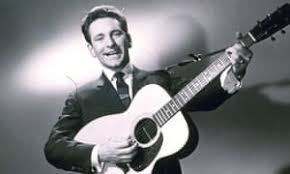
LONNIE DONEGAN interview with Michael Raven 1999

Image of Lonnie Donegan with his guitar
Lonnie Donegan with his guitar

I first met Lonnie Donegan in 1971 when I was accompanying Mary Hopkin at the Winter Gardens, Margate. She was top of the bill and by then Lonnie was not the name he had been in the Fifties. He was striving to make a come-back and was racing up and down almost daily from Margate to recording studios in London. Incidentally, he told me that the way he worked was to perform one song almost endlessly for up to three hours so that everyone became almost mesmerised and all the nooks and crannies of the music were fully explored and the performance was uninhibited. Perfection was not the aim; intensity and excitement were the order of the day. Let’s face it, those early hits were more shouted than sung, but the power was there.

No one should forget that it was Donegan who started not just the skiffle boom (which originated in down town Chicago) but that he also provided the model for the thousands of pop, rock and blues bands that developed in its wake. Quite simply, modern popular music began with skiffle, and the debt that the world owes that little Glaswegian is inestimable. Before Donegan there were solo artists with session man bands or orchestras. The ordinary bloke didn’t have a look in. Then there was this wild homespun music on the telly and Lonnie telling us he only knew three chords and how easy it was. It was him saying this that got me started. The manufacturers and shops weren’t ready for the demand and most of us started on horrendous things from the Far East with telephone wire for strings and half-inch high actions. When Lonnie performed at the Albert Hall last year a host of stars were fighting to share the bill as support acts. If only he got his management sorted he really could hit the big time again – even in his mid-60s. Perhaps the most illustrious of the early skifflers, by the way, were the Beatles.

Anyway, I arranged to see Lonnie when he came to Hanley late last year. He was guesting with the Chris Barber Jazz Band, the outfit with whom it all began. There was no way he would have recognised me now, of course, but as I stood there watching the band doing sound checks, Lonnie passed me twice. The third time he said: “You still here? Do I owe you money or something?” Actually, I learned later that he did know who I was. This was an example of his Southern humour, which tends to be sarcastic and can on occasion upset people who are not aware that it is, in fact, a sign of friendly familiarity.

I had a long chat with Lonnie in his dressing room. The man is a power house, though he is having to learn to slow things down a bit. His performance on stage that night was superb. He is singing better than he was 35 years ago – mellower now but still exciting. And he didn’t cheat his audience. We got most of the old hits, not just a load of nondescript new stuff – a trap fallen into by more than one old timer.

This, then, is an abridged transcript of my conversation with Lonnie at the Royal Theatre, Hanley on the 9th of December, 1999:

MR: How long have you been in Spain now?

LD: About nine years. The principle of the pad in Spain is that we have been getting so much work in Europe that we needed a base over here. It’s a very long commute every fortnight to California. I’m domiciled in America now, a Permanent Resident, an alien …… beam me up Spock! We live in Lake Tahoe.

MR Do you do much in America?

LD: No, very little now. I used to.

MR: I remember when we were at the Winter Gardens you told me you had seen Frankie Laine in Las Vegas, when you were playing across the road from him.

LD: Yes, that’s right. He’s passed away now, hasn’t he?

MR: Not surprising really. You were saying that his voice had gone even then; that people were really coming to see a legend.

LD: Lovely bloke, but he had a problem with me because apparently he had just recorded Rock Island Line, got it in the can, and then mine came out. That was a bit lucky for me.

MR: I see you still play proper instruments. What do think of synthesisers and the like?

LD: I play a Martin 0008 and a Vega de Luxe banjo. The band is still more or less a skiffle line up with a drummer-cum-washboard player, a guitarist and Chris (Barber) on bass. Synthesisers are OK in the right place, but I wouldn’t use one live, or on a skiffle record.

At this point Lonnie’s son, Anthony, came into the room. I was introduced and asked Anthony if he did anything musical. At this Lonnie quipped: “No, he’s my son!” In fact, he plays drums and guitar but is not planning on having a career in music.

MR: You haven’t actually married Sharon yet, have you?

LD: 19 years we’ve been married! What you’re thinking of is that we renewed our vows – there was a splash in Hello magazine.

MR: Oh! So that’s what it was. You’ve died and come back again, as it were.

LD: I’ve nearly done that, as it happens. Two heart operations, but I’m still here.

MR: You don’t have a Scottish accent?

LD: Neither do you!

MR: But I wasn’t born in Glasgow.

LD: My father is Scottish, my mother is Irish, but we left when I was two and came to London. I’m an East-ender really.

MR: When did you start playing any kind of music?

LD: Guitar, when I was 14, singing House of the Rising Sun and Frankie and Johnnie. Same as I am now; it’s taken me this long to learn the words!

MR: Amongst contemporary artistes, have you got any particular people you like, or dislike?

LD: Well, yes. Actually, I’ve been doing a lot of work lately with Van Morrison, who is a skiffle disciple, apart from his own poetic work, and we have a new album which is coming out in a couple of weeks, on January 4th, on BMG and Van is singing a couple of tracks on that – Alabamie Bound and Muleskinner Blues. In fact, the album is called Muleskinner Blues. We have just done a live recording in Belfast together; Chris came along and we’ve been doing a lot together. So, if you ask me who amongst the contemporaries, I’d say its Van Morrison for me. (Lonnie can be rather modest at times. On the record he mentioned, about half the tracks were written by him.)

MR: Do you still enjoy touring?

LD: The travelling gets me down, not the playing – it’s the travelling. You’re paid to travel; the playing is fun.

MR: What are your tastes in music? What do you listen to for pleasure?

LD: I’m a Liquorice Allsorts person – bit of everything. If it’s late at night I might play some Delius – something classical. If I’m in a fun mood I put on some jazz, even a country record or a bit of Emmylou Harris.

MR: At Margate you were as much a comedian as a singer. When did humour become a part of your act?

LD: I’ve always been funny, from when I was very young. You’re either funny or your not. Chris (Barber) will never get laughs. I’m an entertainer: that’s the basis of everything any artiste does. You’re there to entertain – doing whatever you’ve chosen to do. If you’re not there to entertain – get off. If you’re there to indulge yourself – go and do it in the bathroom! I chose folk music and a few facetious retorts. (Yes, he can be facetious, as I have already mentioned, but he is also a very good stand-up comic with a ready wit.)

MR: What did you do before joining the Chris Barber Band?

LD: Selling, selling shirts…sweeping up roads.

MR: Now listen: why don’t you go out on your own? It’s you people want to see. You don’t need a band. You could go out for less money and establish yourself on the festival scene. You’d not only be a major draw but you’d come up with the goods. An awful lot of name folk artistes wear emperor’s clothes. There is certainly no one around who generates the excitement that you do.

LD: No. I’m a band man. I need them at the back of me. Anyway, I’d go out for the same money, even without a band. I have done it, you know. Sitting on a stool and going through my life’s story. It was a two and a half hour show. The hardest part was the first half where I just sat on a stool and did gags and went through my life story. The band came on in the second half. No, solo is not for me. Besides, being on the road without a band is so boring. I’d die of boredom. Someone once said: “Well do it as a beginning.” “Beginning?” I said, “I’m ending!”

MR: You live in Spain a lot these days. Do you like flamenco?

LD: Yes, I love it, and it’s pure folk music, you know: it comes from the people and was not foisted upon them by composers. Its self expression, passion, emotion, and that’s how I work. I like natural music. If you go down the pub and someone sings, they’ll sing (he demonstrates in a coarse, strong voice). They won’t go (demonstrates in a high, refined voice). That’s a false sound; not a natural sound.

MR: Well, that’s your ‘two songs to go call’, so I’ll be on my way. It really has been so nice to see you again.

With that, a virtually naked Lonnie Donegan scampered across the dressing room to don his stage clothes. He looked so little, even fragile, yet so full of energy that if there was a power failure all you would have to do is plug his big toe into the mains and he’d light up half of Hanley. I’ll tell you something; if Martin Carthy is deserving of an MBE, then a knighthood would be hardly good enough for Lonnie Donegan.

SIMON JONES meets the man (1999).

15th April 2019 will be the 11th anniversary of Michael Raven’s passing at the age of 70. In order to commemorate his life and work, I am publishing this interesting interview he gave to Simon Jones in 1999.

Image of Michael Raven at his desk, Ashley
Michael Raven at his desk, Ashley

RAVEN ON

SIMON JONES meets the man who’s nearly done it all, MIKE RAVEN; hearing yarns of the early folk scene in Birmingham, lots about animals, Mary Hopkin, Lonnie Donegan, local history, how the police make good demolition contractors, the anti-hunting lobby and the terrible truth of Martin Carthy, flamenco guitarist!  

Don’t you wish you could do what Mike Raven’s done? It seems he’s done pretty much whatever he pleased and there isn’t really anything he hasn’t had a bash at. In a life inadequately described as ‘full’ he dismisses forty years or so with a smile of the face and an easy-going phrase, “I like to keep busy.” We meet on a glorious afternoon, the sun out and a high breeze.

“ I love this area, “ Raven offers as we sit round a table, piles to talk about and so little time to do justice to such experience. “ There is so much in Cheshire, Shropshire and Staffordshire if you scratch the surface, stop, take time to talk to people and listen.”

He should know, covering three or four counties he complies books of local history, books of Victorian photos and then gazetteers as thick as a Liverpudlian accent. His attention to detail is amazing.  “I like to amass information,” he bluffs “and I admit I see things as a challenge. If somebody says to me they want an article on a castle in, er… I don’t know, let’s say Market Drayton, I have to find out about it lock stock and barrel.”

Besides publishing most of his own work, he writes a wickedly-observed column for County set magazines – you know the sort, glossy ads for houses nobody can afford and pages of Society photos of nobody you’ve ever heard of – called Raven’s Eye.

“I love that,” he grins: “you can put anti-blood sport rhetoric on the next page to the local Hunt.  I like to live dangerously!” And if there’s one thing bothers Mike Raven it’s blood sports. He is vociferous in his denial – why so?

“I love animals; always have, since I was a child. I won’t go into details but I think hunting, especially fox hunting, is loathsome. There’s just so much that’s repulsive.  I must admit to being active as far as banning hunting is concerned.  I’ll take photos, write articles, go on protests, whatever. As much as I like the traditions of our country, this is one that could happily be consigned to the dustbin.”

‘The Unspeakable Chasing the Inedible,’ he blazoned across full colour pages of a Staffordshire journal.  His own conversion involved the painful loss of his beloved dogs to a gung-ho idiot with a gun; he still finds it hard to talk about the occurrence. Back in the mists of his own past he was once described as the “Robin Hood of the Black Country,” by a local paper which documented his RSPCA, PDSA activities. At mention of that he just smiles.

Let’s talk a bit about music Mike; after all it’s about time we did. Where did it start seriously for you?

“My father had a liking for classical music, so my brother (John) and I grew up with Mozart ringing in our ears, but I learnt to play guitar while I was at Keele University.  I got into skiffle through Lonnie Donegan, who was an early hero. I got to meet him many, many years later when he was trying to re-establish himself. He’d bash out his skiffle hits every night at volume but the theatre establishment wanted him to play it safe and go for ‘family’ entertainment. I remember thinking, ‘God, this guy began something which turned music upside down and you want him to come to heel?’ It did, you know: skiffle was the root of rock and acoustic music in this country. It had feet in so many camps and turned so many people on to the fact that you could make your own tunes. This was twenty years before punk. Lonnie Donegan started it all. Thankfully now he seems to be getting his due recognition.”

This was? The late 50s?

“Yeah, about the same time I got hooked on flamenco guitar. I remember having a conversation with Martin Carthy about this and he confessed that he’d once tried to be a flamenco picker. Between University and various jobs here and there I was taught by a genuine gypsy in Barcelona and I spent time in Andalucia and Granada playing there with guitarists in the local bars.”

Returning to England, he and John got together to play folk music around Birmingham. It wasn’t long before they really were the centre of the Black Country trad circuit.

“We started a folk club in Wolverhampton and began researching old industrial songs, some ballads and we wrote a few ourselves in similar vein. As trios were all the rage in the early folk days – you know Peter Paul & Mary – we enlisted a flute player called Derek Craft and we bashed around the Midlands for years as The Black Country Three. We had an odd repertoire but we did loads of work, TV, radio: all short order stuff, phoned the night before – write a song and sing it in studio the next day. We were genuinely popular and I think we did have a huge impact on local research and folklore in Birmingham.”

Their voices were heard beyond too, they got to cut an album on the prestigious Transatlantic label, home to much of the happening folk action of the day, and a right lot they look on the cover: all suits and big smoke stacks in the background – very atmospheric. Rumour has it they were being chased by Philips for a follow up, “but we split up. There was the usual ‘musical differences’; so I went on to work solo and, to be honest, found that just as lucrative. Work came in from radio and television; I was, after all, one of the few guitarists who did a purely instrumental set.”

So it was guitar all the way until you got to play with Mary Hopkin?

“I did; that was a bit later, though, about 1971. I was her accompanist whilst she played on the south coast. A great girl – she was barely twenty when I worked with her, but whoever chose her music should have been shot; I mean, KNOCK, KNOCK!  She wanted to be more singer-songwriter but it never happened, which is a great pity. Anyway, she dedicated herself to her family and, as far as I know, was quite happy to do that.”

Not long after Mike found a partnership of his own; a visit to a folk club in Stafford brought contact with Irish/English singer Joan Mills.

“Her mother was Irish,” Raven relates with a twinkle in his eye. “We’ve recorded ten albums or so together and worked with a band called Reynardine. It grew out of Irish sessions in Birmingham – Joan and me, a whistle player and a fiddle player.”

The results of the union are part of the Raven archive known uncannily as THE REYNARDINE TAPES. Yet, surprisingly, “We gave up playing folk music live for a time, though we still recorded.”

And you began to write guitar books and music books in general which often reflected what you were fascinated with at the time.

“Yes, I’ve done about eighty or so,” he deadpans, “but it isn’t all guitar music; there are books about dances, folklore, history and poetry. The death of my dogs got me writing poetry.”

What constitutes a Raven /Mills performance these days?

“A real mix of things actually; I don’t think you could actually say we play folk music in the real sense. There would be some Welsh tunes – I was born in Wales and got into Welsh music latterly – and I’ll play some lute-type pieces, which is another interest of mine. We rework the poetry of people like Housman to traditional music and I might even play a flamenco piece for old times’ sake.”

Raven’s regionality is something of a trademark specialism; not only does he trundle round Cheshire, Shropshire – where he now lives – and Staffordshire, but he digs wider into the border country of England and Wales, issuing recordings rooted in counties like Herefordshire. Strange to tell too, that for a man so steeped in music, he actually gave up playing his guitar for two or three years whilst working up his massive regional guides. As he puts it: “I climbed hills, nosed in churches and saw more secret places than you’d find if you searched with any old gazetteer. I had to give up everything else though; it really took time.”

First came the Staffordshire volume and then the Shropshire edition. “I’d like to do one for Cheshire,” he muses, as the tape clatters noisily to a stop.

And there’s more to Raven: his tales of life in the army really should be put into print and his guise as a landlord/building renovator, a phase of his life exemplified by the Stafford police bursting through a house wall in one of his properties on the pretence of looking for drugs. “They never found an ounce,” he mutters. “Took me years to get them to pay up for the damage.”

I flick casually through some promo pictures. On each of them, whether with Joan or just his guitar, Mike Raven looks the very picture of concentration. The same inscrutable gaze 1959, 1969, 1979, 1989 and, you guessed, it 1999.

Had he ever thought of putting his life into a book?

“I’ve thought about it, but tell me, Simon, who’d believe it?”          

Look out for the next blog: the interview Mike did with skiffle king, LONNIE DONEGAN 

Bill Caddick conversation with Michael Raven

Bill Caddick:

in conversation with Mike Raven

Bill Caddick, at Jackfield, March 2000.  Photograph: Mike Raven

Bill Caddick is one of our most highly respected singer-songwriters. He has had a long and varied career, both as a solo artiste and as a member of several groups, including The Albion Band and Home Service. Many of his songs have been covered by artistes of the first rank, including June Tabor and Christie Moore. In March 2000 I spoke to Bill at his home in Shropshire and he was very forthcoming about the way he writes and composes.

MR:     When were you born, Bill?
BC:      27th June 1944, the day that Cherbourg fell to the Allies.

MR:     And where were you born?
BC:      A place called Hurst Hill, Coseley, just on the outskirts of Bilston in the Black Country. It was really good – a sort of industrial slum, but a hundred yards away was a farm. It was great: a wonderful childhood.

MR:    And what did your parents do?
BC:    My father worked in a factory, practically the same factory shop all his life. I think it was 57 years he worked at Thompson’s, a heavy engineering place. My mum did all sorts of things, cleaning and waitressing, all sorts.

MR:    Where did you go to school?
BC:     I went first of all to Sedgeley, to a Catholic school there – my mother was a Catholic – and then I went to Tipton Grammar School, a wonderful place. It was like Bleak House. There was a factory over the road, on one side, a cemetery on the other, the canal at the bottom and a gas board waste ground next to it. They were wonderful surroundings – very picturesque.

MR:    I know, I lived in Wolverhampton until I was about 25 when I escaped. There is a kind of romanticism about these grim industrial areas – certainly when you’ve left and come back to visit. I’m not so sure whether people who live there all their lives feel the same, though.
BC:    When they demolished our house they moved us to the council flats at the side of Sedgeley Beacon, and I used to go up on to the Beacon and look down over Bilston. You would just see the brown smog across the top of it. I remember driving home from places and you would suddenly see the air change and think: “Here we are; we’re back again; we’re home”. If you grow up in that environment, you accept it.

MR:    I live near Stoke on Trent now and there are these derelict areas along the canal, and it’s with an air of wistfulness you look at them.
BC:    I think it’s really sad. If you get the train from Wolverhampton to Birmingham, you pass Monmore Green Greyhound Stadium, and where the steel works used to be is one huge flat area. I remember the steel works: a lot of my friends went to work there, and it practically shut Bilston down when they closed it, and they didn’t just close it – they flattened it within months. You think, I remember that place. You would sit on the Beacon and could see the molten metal going along the rolling mill. At night you would see the glow of it; it’s all gone. It seems a bit sad.

Site of the Bilston Steelworks, 1991. Photograph: Mike Raven

MR:   I know; I went there when I was doing my Black Country Towns and Villages book. I thought I’ll get a picture of at least the site of Bilston Steel Works, but, as you say, it’s totally flat, and all I could get was a picture of two gypsy lads playing on the edge of it.  In fact, it’s rather a nice photograph because they are really cheeky. When did you become interested in music?
BC:    Well, my father was well into opera – tenors especially.  He had lots of 78’s of tenors, which he played all the time, and the radio was always on.  I remember my mother saying she wasn’t surprised when I went into music because he always put me in a cot next to the radio. It’s very odd, but I still know the words of the strangest songs. My father-in-law plays piano. He will play all night without pausing, and I know all the words to these songs which were popular before I was grown up. They just seem to have filtered in somehow. Then, when the skiffle boom started, I got a guitar and had three lessons, and at the end of it there was a mutual decision that there was no future in it for me, so I stopped. For the same reason, they wouldn’t let me in the school choir because I couldn’t sing. Now I’m a doddering old fool singing and playing guitar for a living. I took up the guitar again when I went to college and suddenly found I could play it.

MR:    Which college was that?
BC:    In those days it was Lanchester College of Technology, in Coventry. Now it is part of the University of Warwick. I did a degree in languages and business studies.

MR:    So you did get a degree? I always thought that was a joke.
BC:     No, no, it was a business degree with special reference to modern languages – French, German and Russian – as well as economics, statistics, marketing, advertising and law. By the time I had finished college I realised that was not what I wanted to do, and I was seriously into guitar playing and folk music by then.

MR:    What did you do after you left college?
BC:    I got a job after a while. I had bought my 12-string guitar and my main preoccupation was learning how to play like Leadbelly.  Eventually my parents said: “You will have to get a job, doing something”, so I got a job selling aluminium foil – not on the road; it was from an office. I was in export sales first and then home sales. I was there for seven years, at Star Aluminium in Wolverhampton. In the end they wanted me to weld the two departments
together. I was doing a lot of gigs at that point, doing a lot of travelling at night and coming back and doing my job in the day. Then Taffy Thomas said: “Do you want to join Magic Lantern puppet theatre?” so I did, and have never looked forward since. Star Aluminium offered me a lot of money to do the selling job but I turned it down and did Lantern for thirty quid a week.

MR:    You were doing a lot of gigs. What sort of material were you doing?
BC:     I was already writing. I started off doing Dylan and Leadbelly and Paxton, all sorts of things.

MR:    So you were doing a mixture of mostly contemporary, a bit of blues and some of your own?
BC:    Yes, the strange thing was that I was really interested in traditional music. I used to buy all the Topic compilations that Bert Lloyd did, and I used to love listening to them, but I never actually sang any of them. I was more-or-less strictly contemporary or blues. It’s only recently that I’ve started doing traditional stuff. I don’t do many because people book me as a songwriter. I think the first time I performed traditional music in public was with the Albion Band. You join a folk-rock band and you end up doing traditional music.

MR:    How long were you with Ashley Hutchings?
BC:    Just over two years, I think, and then The Home Service grew out of the Albion Band. It was ironic really. Albion Band were rooted in the National Theatre by that time, and a lot of us wanted to get out on the road, so we more-or-less all left the Albion Band. Actually, there were several Albion Bands going at that time but we were the main one. We formed the Home Service with a view to going on the road and, immediately, we were offered jobs in the theatre doing the Passion Mysteries and Don Quixote and things like that; and we stayed there whilst the Albion band haven’t stopped touring since, strangely enough.

MR:    You were living in London now, were you?
BC:    Well, not permanently. When the runs were at the theatre I was living there five or six days a week, and rushing back to Wolverhampton for some sensible beer at the weekends. It was much later I moved down to London for a bit, to actually live there. I quite enjoyed being in London when I was working in the theatre and able to come back to Wolverhampton – Sunday and Monday usually – but when we actually moved down there I never went into the West End, or walked round, which I used to do all the time when I was working there. I just didn’t like being there at all. I was very happy to move back up here.

MR:    When did you come back – you came back to Shropshire?  Why?
BC:     Well, Katherine, my wife, is from this area.

Bill Caddick and his wife, Katherine, at Much Wenlock, 1994.  Photograph: Mike Raven

MR:    When did you meet Katherine?
BC:     It was after the theatre and after the Mysteries finished. It was very hard work. It was all of the Bible, from Genesis right the way through to Doomsday, Revelations, the lot. On Saturdays we did all three plays. We were there all day; matinees several days a week and most nights. It’s very physical work. You are running around in three costumes and changing and doing all sorts of things. I think everybody – the band and the company – were all drained at the end of it. I had a bit of an altercation with the other guys in Home Service and said: “I’ve had enough. I just don’t want to do this any more”. I came back to Wolverhampton and got myself an allotment, and that’s basically all I did, and then got myself a part-time job at New Cross Hospital in the psychiatric department. Katherine was running an art room there and I was helping her out, and that’s where we met.

MR:    When did you get married?
BC:     Three and a half years ago. We’ve been together about 10 years now.

MR:    How old is your son, Tam, now ?
BC:     He’s nine this year. He’s a smashing kid – he’s got really nice values, but if you see him out at festivals he will be racing around, unless his attention’s actually being drawn to something like a children’s activity thing, and then he’ll be there, in the middle of it, doing something quietly. I wish I had half his energy.

MR:    Now, writing of songs. I’ve got your Winter Flowers CD in our internet Folk Shop and I wrote this little note against the record: “Let Bill Caddick ride the highways and byways of your mind.” To a degree that is what you do,
because, although it is your mind, people will relate to it through their own minds.
BC:    That is the idea.

MR:    Because that is more-or-less what you do, isn’t it? It might be a global subject, but you do it from a personal point of view.
BC:    I think the songs have got more that way as I have got older. On the record Sunny Memories, which became a show, I wanted to reflect aspects of Edwardian life, mainly using people’s diaries and recollections and using the styles of music that were around at that time. In that sense there was nothing personally of mine, but obviously the things that impressed me would be reflected back. As well as getting the bigger aspects of it all, you have to make it personal. So, obviously you use your own feelings. I suppose any writer would do that really, and I’ve used that sort of technique in most songs. These days the songs have become more personal. There are quite a few songs now in which I’m talking about me. I’m saying “I did this; I feel this”. I don’t really want to go too far in that direction because there comes a point where it just becomes boring for people listening.

MR:    I know Harvey Andrews quite well and he has become very introspective these last few years.
BC:    I think he always was. Some people do like that and some songwriters are in that style, and O.K. there’s a place for it. It’s just that I’m quite a private sort of person, anyway. I don’t want to reveal that much. At the same time, people probably wouldn’t find it very interesting, so a) why should I? People have no right to expect to know all about me just because I’m standing up there singing a song to them; and b) they might not find it very
interesting anyway, and that would be devastating, if you banked your whole career on that.

MR:    I know you’ve got a thing about not reading the words to a song by themselves, haven’t you? You feel you should only read them if the song is to be sung.
BC:    Well, you can, I suppose. If I’m writing I try to get the words exactly right and try to have an element of poetry in them. Ira Gershwin said: “You should never read the words of a song in isolation”.

MR:    Which probably means he was a good songwriter but a bad poet.
BC:    Could be. They don’t go together.

MR:    They can do, of course.
BC:     Well yes, you can set poems to music, and the words of a song can be poetic, but songs and poems are two different fields.

MR:    Now you say that but A. E. Housman utterly refused to have his poems recited on BBC radio. He said: “You can only broadcast them if they are set to music and sung”.
BC:    Oh, really? That’s interesting.

MR:    Although his poems sound very well indeed when recited.
BC:    Which is not that common. You hear a lot of poets on the radio reading their stuff and most of them are rubbish. They really put you off. You think: “I’m not going to buy that book.” They sort of declaim it or a different voice comes in. I hear storytellers do that as well. You can be speaking to them one minute and then they get on the stage and a different voice comes out.

MR:    Yes, I remember discussing this with the late Richard Walker, the story teller. I said: “My idea of a storyteller is an old man with a beard, a wise man, a keeper the tribe’s history in aural form, sitting in a chair and telling you a story as though it is true – as though he really believed it, and was gathering you into it, transporting you if you like. When people do this declaiming stuff to large audiences, standing up waving their arms, it’s not drawing you in at all. They talk to adult audiences as though they are children, and when they make deliberate eye contact, well, I find that quite discomforting – embarrassing, even. In the Hebrides the traditional epic ballad singers turned to face a corner of the room so that the words of the story spoke with as little dramatic interference from themselves as possible.
BC:    It doesn’t work with me, anyway.

MR:    No, it’s like watching an actor, but that’s the way it seems to have gone.
BC:    It does, to a large extent. I agree. You sometimes see a person like Packie Byrne telling a story and don’t know that a story’s started.

MR:    No, you don’t know until the end almost.
BC:     It’s like the best joke tellers in pubs. If you are telling a joke in a pub you don’t say: “Right, I’m going to tell a joke now – this bloke walked into a pub.” You just sort of say: “I was driving back tonight and I heard on the radio that they’d caught this bloke nicking battery acid, and another bloke was done for nicking fireworks, and the police charged one but let the other one off”, and you think that was a joke. And that’s the way I like it.

MR:    (Laughs) Yes, it kind of hits you afterwards.
BC:    I think songs have got to be insidious. If you go back to the Sunny Memories thing, quite a lot of them really sneak in. You can get people singing something, especially with a chorus in it, and on the way home they are thinking: “What am I singing about. Oh, that’s what it’s about, is it?” That’s nicer. This is what I was saying about the element of communication, especially in the chorus. If people can hum something or find what they call
the hook in a song, they can’t get it out of their heads and you have got them then. Once you’ve got a good song with all those elements in it, you can say what you like then, and they’ll sing it: “I’ll give you all my money!”

MR:    That’s right because it’s a communication. You don’t have to understand the exact words. A good song doesn’t have to have a wonderful tune and fantastic words and a marvellous arrangement and a great singer, does it?
BC:    It does help though!

MR:    Of course it all helps, but it doesn’t have to have that. You can get the most banal things, such as Let’s face it, a lot of 12-bar blues. Many of these old blues singers were singing a load of old cods: “My baby done gone left me”, or something, and they’re not even singing it as though they really mean it half the time. It was just a kind of feel-good-type thing, but it worked. All it’s got to do in the end is work, isn’t it, no matter how it does it?
BC:    Yes, that’s true.

MR:    What are you doing theses days, Bill?
BC:    Well, I keep on trying to record a ‘best of’ album. Only The Path and Winter with Flowers are still available. Everything else has been deleted, and people keep asking me where they can buy John o’ Dreams or Unicorns with me singing it, and they can’t. I thought I’ll just sit in a studio and do it. I keep swapping between two ideas – whether I get people in to help me do it or whether I just do it and sing it on my own

MR:    Can I just interrupt there. That is a growing trend and one I’ve always supported – people doing on CD how they do it live. Ian Bruce will tell you his best-selling album is just him and his guitar. Show of Hands say that their next recording will be ‘as live’. Then there are two old-stagers – Tony Rose and Chris Foster – who have made comeback CD’s with them playing entirely solo, as they do in the clubs.
BC:    There’s a place for both. It’s just that I wanted to do these as my definitive version. How I do it. If I do it with a band it’s going to be different.

MR:    Yes exactly, and the reason I would try and persuade people to go in a solo direction is that it’s forever. It’s once and forever. That was you singing your song. Backings can be very of-the-moment things and can become dated very quickly. Anyway, unless you can afford the very best musicians, band accompaniments can be rather lacklustre creatures.
BC:    Actually, I’ve done quite a lot of studio tracks and I’ve got three CD’s worth of doing it ‘as live’. The problem is that I don’t like listening to myself by myself, so I’ve got these three CD’s and I don’t know what to do with them basically. I don’t know whether they are any good even. I’ve not played all the way through any of them, so basically I think I’ll just carry on doing a bit more of that. I’ve done some of the tracks in the studio and live, and I’ll just
shovel them over to somebody and say: “Just make an album of this, will you?”

MR:    I know, because I’ve always done this with Joan. I play guitar and she sings. When we started off we had so much material that we filled the 80 minutes up in order to archive it. However, people were complaining that our CD’s were too long, and, whilst I am very glad that we did that, I have come to think that if you can’t beat them, join them. If you are doing it ‘as live’, as you would in a folk club, you have to keep it to LP length, about 45 minutes,
and you have to carefully choose the order in which the tracks go, and you may do a little instrumental or even a bit of talking just to break up the endless flow of one guy singing.
BC:    The other project which I have got on at the moment, which is taking me a while, is an album of new stuff and a lot of it I want to be orchestrated. The basic idea behind Winter with Flowers was to use a lot of English traditional dance musicians – basically a band called All Blacked Up, a local band who all lived in Broseley, and a few others – but to push them a little bit and put in some slide guitar and 12-string guitar, so that you got an English feel but
with American influences. This time, for part of the album, I want to go a bit more Ry Cooder meets Vaughan Williams, so there will be a lot of slide guitar in it but with orchestral instruments as well. At the same time have some voices, so it’s a big, complicated thing. I really haven’t had the time to sit down and work at it. I probably need a fortnight of not sleeping or eating much, and
nobody coming near me, to get it done. As well as that, I’ll be doing a lot of research into the song Peat Bog Soldiers. There’s a fascinating story behind it, which is not at all what people thing the background to the song is. I would like to do a dramatisation of that on record, and perhaps even do it live as well. The
trouble is it was done by prisoners first of all, and finding 16 thin people who can sing is difficult these days! Everybody is obese. I’m working on five or six different things from this album and there’s got to be some sort of cohesion, some sort of flow in the whole thing, even though it may not be apparent to anybody else. For me there’s got to be some reasoning behind it. I think Colin Irwin said I’m a devious constructor of albums, and I do always think that way. If I’m doing a performance there are little sets of songs that go together, and,
though it may not be apparent to anybody else, it’s important to me that there’s some logic behind the whole thing, which is quite at variance with my character because I’m not really a logical person.

MR:    A lot of poets say they can’t sit down to write a poem to order, that’s why you get some very bad poetry from poet laureates when they have to write a poem on the death of so and so, or to celebrate the day the Queen sneezed in public for the first time. The muse has to strike them. Obviously anyone can sit down and write a song or a poem, but will it be a good one – does it work?
BC:    You have to work. There’s lots and lots of days when you come to the end of the day and you haven’t really got anything.

MR:    Do you keep notebooks at all.
BC:    Yes, tons of stuff. I never throw anything away – words or tunes.

MR:    You can read and write music now, can’t you?

BC:    Yes, not with great facility. If somebody presented me with a new piece of music I’d have trouble playing it straight off with any fluency, but I can jot down a tune. I used to rely on cassette recorders or my memory, or just writing guitar chords, but I’ve got a music programme on my computer and I’ve started playing with that. It’s actually taught me a lot about music and now I do write it out. I can transfer it on to the computer and it will tell me if I’ve written it out correctly, which is great and has enabled me to do all sorts of things like arranging orchestral stuff, although I’ve got a lot to learn about that yet.

MR:    What’s your dog called?
BC:    Bess.

MR:    Why do you call her Bess?
BC:    Because she’s black and it’s a short name, and dogs love short names. She’s called Bess after Black Bess.

MR:    Oh, I see – Dick Turpin’s horse, Black Bess. I’ve always been intrigued by him, I must admit. There’s a song about him, collected near here, in Broseley from May Bradley.
BC:    Oh, really. I didn’t know that.

MR:    Yes, she did a song called Turpin’s Farewell to Black Bess. She only had the chorus and the tune, so I wrote some verses for it. We did it at the Remembrance Concert for Richard Walker.
BC:    Oh yes, I remember now.

MR:    It’s a very weepy sort of thing, but lovely. It’s about him having to shoot her to put her out of her pain. That’s a thought, you know, because I’ve got this big, black dog called Bruno, a cross between a Rottweiler and a great Dane. He is a brute, and he is ugly, and he is vicious and aggressive and he nips people.
BC: They say owners start to look like their dogs, don’t they!

MR:    And he has afflictions. He tends to get eczema and his eyes go funny occasionally. He’s a total mess, this dog.
BC: But you love him dearly.

MR:    You stole the words right out of my mouth. A couple of times we’ve been to the vet and the vet has looked at me, half in wonder and half in disgust, as if to say: “What are you bothering with this horrible, snarling thing for, which has to be muzzled and goes berserk when I stick a thermometer up his backside. And I think, “He just does not understand, this vet.” This dog loves me beyond all imagining, and I love him beyond all measure. He can’t understand that. He just wants to put the creature down. I think there are songs like that. Some pop songs stick in your head, and you think “Why is this going round and round in my head; it’s a load of meaningless old cods?” Anyway, you’re living at Jackfield now, and you take your dog for a walk every morning.
BC:    Yes, it’s the best part of the day. Usually I do the school run and then come back and go off with the Bess. It can be half an hour or so, or we can do the long walk, which is far as Coalport Bridge, over the river there, and back over the new bridge, which is about four miles.

Bill Caddick at Jackfield, 2000.
Photograph: Mike Raven

MR:    I must say, it’s very nice round here – very rural. You’ve got the woods and the River Severn, and the whole gorge is quite dramatic.
BC:    It’s beautiful. I love it. We just walk across the road there, and you’re into the old railway line that used run all the way up to Shrewsbury.

MR:    However, this neck of the woods was notorious in the last century, wasn’t it?.
BC:    It was the brothel area for Ironbridge. Someone said the other day, there were 87 pubs at one point in this area, but when most of the village started collapsing into the river in the 50.s a lot of them went, leaving the Robin Hood, the Half Moon and The Boat.
MR:    A lot of there customers were bowhauliers. Anywhere between five and fifteen pulled Severn trows upstream from Gloucester. They used to steal anything not nailed down, slept rough, killed sheep, and must have been a very tough lot. How old are you now, Bill?
BC:    Fifty five.

MR:    I’ve got seven years on you.
BC:    You must be one of the few people who has. There’s you and Martin Carthy, and Harvey Andrews, of course.

MR:    I said in an article of mine. I’m one of the few people who is older than Carthy, and that’s pretty ancient.
BC:    He’s about 112, or something like that, isn’t he?

MR:    In his head he is.
BC:    I think he’s from the Planet Zog, though, Martin. He’s not of this world. I once took him round Wolverhampton and he wanted to buy some white shoes. He’d got some white shoes on but he wanted another pair. We went to literally every shoe shop in Wolverhampton – and there’s quite a few – trying on every pair of white shoes they’d got, but he didn’t buy any. I’ve got a load of time for him, though. I think he’s a brilliant bloke. I love his individuality and his eccentricity. I also like the way – no matter what else he’s involved in – he always insisted on doing folk clubs, which I think is great because I love the immediacy of folk clubs. I know they are not popular these days but I like the fact that you can get up in a room and just sing and say what you like, and get an instant reaction from people. I can’t understand how people can think they are stars of the folk scene, because it is just not like that. It’s in the back room of a pub that may not have been cleaned for ages but there’s always some little gem that comes out. You can sit through all the average floor singers and
then somebody will get up and sing a song – possibly that they have written themselves – and it’s brilliant. And you think: that’s it; that’s why I’m here.

MR:    I totally agree with that. You get those little magic moments, when something just works. And what people forget is that it’s very hard, especially for residents and, equally for floor singers. If they are getting up and doing one or two songs every week, they cannot keep repeating themselves and so, often, they are doing completely new stuff. They can’t trudge round like the professionals can, doing the same 15 songs every night.
BC:    I’ve been involved in running, and being resident at three or four clubs, and it isn’t easy. To do it properly isn’t, anyway.

MR:    Perhaps we can talk a little bit more about songs. You didn’t answer my question about sitting down and writing songs.
BC:    I do, yes.

MR:    Generally speaking, do you find they are successful compared with ones that jump out of the air?
BC:    I don’t really believe in songs that jump out of the air, though I must admit that Unicorns and John o’ Dreams were like that and they have been very successful. I’m a worker, though I get a limited amount time some days by the time I’ve walked the dog, taken Tam to school and done whatever jobs have to be done. I suppose it’s my office training, but I do try and get to work by a certain time and only stop for half an hour an lunchtime, and then work again.

MR:    That’s what you do most days – sit down and write songs?
BC:    Yes, although some days I just play guitar. I’m learning to play the fiddle, and practise that for an hour or so. I don’t regard that as work. Playing the guitar is different, because something usually does come of it. Even if you don’t come up with anything you can quote to somebody, you are always working towards something. I like to take a long time over a song and get it absolutely right, which is why I don’t trust the song which just pops into your

Bill Caddick and his son, Tam, at the Festival on the Edge, Much Wenlock, Shropshire, 1994.
Photograph: Mike Raven

head. I’m always a bit suspicious about that. I like to get the words exactly right. I could turn out a song a day; wouldn’t be any problem. When I was working in the theatre you had to do that. The director would say: “I want a song.” I’d say: “How long?” and he’d hold his hands up. “When do you want it?” “Well, now”. So we’d say: “Can we have half an hour?” and the whole band would rush into another room, the actors would go to the bar – very galling – and myself and John Tams, the only ones who didn’t have any proper musical training, would work out a song. At the same time, the guitar player would be writing out the brass section parts, and other people would be learning it, and we’d go back after half an hour with a song. It might not be finished but there would be enough to see what it was like. Some of the actors would say: “Musos, it’s nothing”, and we would say: “O.K., come back in three weeks time able to play an instrument to professional standard and write us some songs, and we’ll come back in three weeks time having learnt your script and your movements, and we’ll see who can do it best.” Today, all the time I spend working is well spent. Even if I haven’t got anything at the end of the day to show for it, something has been logged on at the back of my brain; so when you actually get down to doing it, it’s easy at that point. If you know what the song is going to be about, all you have got to do is decide the style, the key and what it’s going to be like at the end. You’ve got to hear it in your head before you actually write it, I think. You do the words and music together. It’s fatal to try and do one to the other. I find that very difficult. I know you’ve done a lot of setting poems to music. I find that quite difficult, and I’d rather have the two come together, and bend them and twist them until they’re exactly right.

MR:    I know what you mean. I have a little book called The Land of Lost Content, in which a lot of the songs are poems set to music, and I said in the introduction to that that it’s often easier to write a new tune than to try and get a traditional tune to fit, which is a similar thing to what you are saying.
BC:    When we started to do Winter with Flowers, the lads from All Blacked Up would come round to the house and I could hear the things in my head that I wanted, but I didn’t know whether it would actually work in practical terms.

MR:    That was a nice CD.
BC:    There were some very nice bits in it. There is a euphonium in the middle of it, and instead of a bass guitar I used that as a bass instrument most of the time. They said: “What’s the rest of it like?” I said: “I haven’t written that yet”. I know what it’s going to be and could tell you practically all the words, but I haven’t written them down on paper yet. The whole album was written in about a month, but that was working evenings and weekends.

MR:    You wrote most of the songs in that condensed period?
BC:    Yes, which is a great way to work but a lot of work had been done beforehand. I had got notes and ideas in my head, so I knew what I wanted but I didn’t know if it would actually work in that way. Basically, all I had to do was open the tap and let it all come out. It’s a good way of working. I work well under pressure like that.

MR:    Which other song writers do you particularly admire?
BC:    All sorts of people. Early Dylan stuff is wonderful. All the words tumble out of him in a quite anarchic way. On the other hand, Tom Paxton, in the old days, was a quite simple wordsmith. These days I listen a lot to a lady called Lucinda Williams, who has come out of the folk, blues and country scene. John Tams is a phenomenal songwriter, when you actually get him to sit down and do it. Apparently, he has just done an album. I’m looking forward to listening to that, and he’s really good to work with.

MR:    Somebody reviewing one of your albums said you wrote American road songs but set in England.
BC:    Interesting. There is an element of that, I suppose. I basically started playing American stuff and it was a long time before I sang any traditional songs, but at one point my mother, who comes from Upper Gornal, told me about the salt sellers who used to go round in covered wagons and used to park up in the winter in Upper Gornal. She knew all of them – Joey Jiggy and John Toe and Moonshine. I tell you, I could hear the chorus of the song. It was just poetic, and that was the first English traditional-type of song I wrote. All the rest had been sub-Dylan, fake Tom Paxton, or fake blues, and I switched to doing fake traditional songs. I had to make a big jump in the way I played guitar because I’ve always played 12-string, so I had to make that fit and work out a way of bending the way Leadbelly played 12-string, to something approximating the way Carthy played. But I had to adapt it a lot to get an English style, which it isn’t, of course, because there’s no such thing as a traditional English style.

MR:    If there is, it is probably more to do with Renaissance lute playing, or simple chord, arpeggios, Elton Hayes style. I’ll probably be laughed at for saying it, but Elton Hayes was a real troubadour and probably brought folk material to a greater audience than anyone else, with the exception of Burl Ives.
BC:    For a few years now, I have realised that what I had essentially been doing was writing fake folk songs, and I had to stop that because it is a pointless exercise really. They’re there already. You don’t need me to add to them. What is great fun is working with the Jackfield Riverbillies, a country-ish sort of band. I just play slide guitar with them, and writing songs with them means I can go back and just do American-style things, although we try all sorts of bits and dabs. I can sit down and write Country and Western songs – great fun. We used to play at the Tontine once a month but we stopped that a couple of years ago. That’s a totally different sort of discipline. I’ve always liked changing, like playing with the Home Service or with Pete Bond and Pete Laycock. We did some good stuff there. I’ve started doing a couple of things with storytellers. I’ve worked with Amy Douglas. I like to ring the changes.

MR:    What sort of things did you do with her, for example:
BC:    Mainly traditional stuff. We did a thing up in Llanrhaeadr a couple of weeks ago. She has done a lot of research into stories from that area. There was nothing much I could do in terms of songs from there, although there were a few things I found. But there are songs such as Tam Lin and The Two Magicians, which are shape-changing songs, a concept which appears in a lot of the stories Amy tells. We did Tam Lin as a combined story and ballad.

MR:    Richard Walker booked me once at a Wilderhope Manor storytelling weekend with Hugh Lupton and others. My brief was to play a guitar solo after each story. I had no idea what they were going to do and I had to think pretty quickly of something that related to the story they had told.
BC:    I’ve done two things like that at the Festival of the Edge with Dan Kedding, where they put us on for an hour and a half and we were thinking, “What are we going to do,” and you come to the end and you think, “Is it over already?” And it does happen. Somebody is telling a story and you think, I know what I can do to tie in with that; or you can just say, that’s over now and it’s my turn to give you a cue now.

MR:    It’s a wonderful exercise. Travelling back from gigs I used to say to Joan: “You name any two things and I’ll find a connection between them in some way”. Like if she introduced a song and then I’d have to link it to a guitar solo and have a justification as to why it was linked. It’s a bit like that. Another way to accompany a storyteller is to play quietly in the background. It makes a difference – makes it more complete in a way.
BC:    More of a performance.

MR:    Short of becoming something like the old silent black and white movies with the piano heightening everything. You have got to avoid that like the plague, because it just becomes burlesque. Well, I think that’s about it. That’s great; thank you very much Bill.
BC:    I hate to tell you this, Mike, but your tape stopped ages ago! Only joking. Anyway, it’s time for the dog’s afternoon walk.

Mike Raven

Bill Caddick Discography

1976 Rough Music
1977 Sunny Memories
1979 Reasons briefly set down…
Larkrise at Candleford
1980 A Duck on his Head (Bond, Caddick, Laycock
1981 Doing the English
1984 Home Service (Home Service)
The Mysteries (Home Service)
1985 The Mysteries (EP, Home Service)
1986 The Wild West Show
1991 Urban Legend
1995 Winter with Flowers
1996 Early Transmissions (Home Service)
Wild Life (Home Service)
1999 Cherokee (Jackfield Hillbillies)

Projected:

Dark Designs (Lorna Bryant CD)
Unicorns (Best of Bill Caddick)
Bill has also done session work on albums by the following artistes:
John Kirkpatrick, Richard and Linda Thompson, Peter Bond, Tim Laycock,
Ashley Hutchins, Jan Davies and Les Barker.

Julie Guy had kindly furnished us with the following information regarding the Michael Raven interview with Bill Caddick:


Bill Caddick’s eldest son, Christy, was not mentioned in the interview. Some of Bill’s earlier songs such as John o’Dreams and Waiting for the Lark were actually Christy’s lullabies. For an overview of Bill’s life, please see his obituaries.

Welcome to my new website and my first Blog post!

Welcome to my new website! I hope the new format will enable me to contribute and share more of my memories of Michael Raven, his music, performances, history and interests.

Below is a video of Epitaph a track from the CD “Flowers of Picardy” – a superb poem by A E Housman, set to haunting music by Michael Raven. Filmed at Cannock Chase German Military Cemetery, where lie German Nationals who lost their lives in the United Kingdom in the two World Wars.

Wish me well in this new adventure!

Joan

Powered by LR Clouds Hosting, Copyright © 2026 Joan Mills