
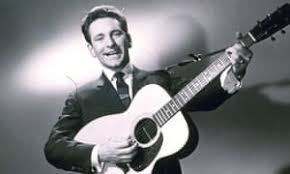
I first met Lonnie Donegan in 1971 when I was accompanying Mary Hopkin at the Winter Gardens, Margate. She was top of the bill and by then Lonnie was not the name he had been in the Fifties. He was striving to make a come-back and was racing up and down almost daily from Margate to recording studios in London. Incidentally, he told me that the way he worked was to perform one song almost endlessly for up to three hours so that everyone became almost mesmerised and all the nooks and crannies of the music were fully explored and the performance was uninhibited. Perfection was not the aim; intensity and excitement were the order of the day. Let’s face it, those early hits were more shouted than sung, but the power was there.
No one should forget that it was Donegan who started not just the skiffle boom (which originated in down town Chicago) but that he also provided the model for the thousands of pop, rock and blues bands that developed in its wake. Quite simply, modern popular music began with skiffle, and the debt that the world owes that little Glaswegian is inestimable. Before Donegan there were solo artists with session man bands or orchestras. The ordinary bloke didn’t have a look in. Then there was this wild homespun music on the telly and Lonnie telling us he only knew three chords and how easy it was. It was him saying this that got me started. The manufacturers and shops weren’t ready for the demand and most of us started on horrendous things from the Far East with telephone wire for strings and half-inch high actions. When Lonnie performed at the Albert Hall last year a host of stars were fighting to share the bill as support acts. If only he got his management sorted he really could hit the big time again – even in his mid-60s. Perhaps the most illustrious of the early skifflers, by the way, were the Beatles.
Anyway, I arranged to see Lonnie when he came to Hanley late last year. He was guesting with the Chris Barber Jazz Band, the outfit with whom it all began. There was no way he would have recognised me now, of course, but as I stood there watching the band doing sound checks, Lonnie passed me twice. The third time he said: “You still here? Do I owe you money or something?” Actually, I learned later that he did know who I was. This was an example of his Southern humour, which tends to be sarcastic and can on occasion upset people who are not aware that it is, in fact, a sign of friendly familiarity.
I had a long chat with Lonnie in his dressing room. The man is a power house, though he is having to learn to slow things down a bit. His performance on stage that night was superb. He is singing better than he was 35 years ago – mellower now but still exciting. And he didn’t cheat his audience. We got most of the old hits, not just a load of nondescript new stuff – a trap fallen into by more than one old timer.
This, then, is an abridged transcript of my conversation with Lonnie at the Royal Theatre, Hanley on the 9th of December, 1999:
MR: How long have you been in Spain now?
LD: About nine years. The principle of the pad in Spain is that we have been getting so much work in Europe that we needed a base over here. It’s a very long commute every fortnight to California. I’m domiciled in America now, a Permanent Resident, an alien …… beam me up Spock! We live in Lake Tahoe.
MR Do you do much in America?
LD: No, very little now. I used to.
MR: I remember when we were at the Winter Gardens you told me you had seen Frankie Laine in Las Vegas, when you were playing across the road from him.
LD: Yes, that’s right. He’s passed away now, hasn’t he?
MR: Not surprising really. You were saying that his voice had gone even then; that people were really coming to see a legend.
LD: Lovely bloke, but he had a problem with me because apparently he had just recorded Rock Island Line, got it in the can, and then mine came out. That was a bit lucky for me.
MR: I see you still play proper instruments. What do think of synthesisers and the like?
LD: I play a Martin 0008 and a Vega de Luxe banjo. The band is still more or less a skiffle line up with a drummer-cum-washboard player, a guitarist and Chris (Barber) on bass. Synthesisers are OK in the right place, but I wouldn’t use one live, or on a skiffle record.
At this point Lonnie’s son, Anthony, came into the room. I was introduced and asked Anthony if he did anything musical. At this Lonnie quipped: “No, he’s my son!” In fact, he plays drums and guitar but is not planning on having a career in music.
MR: You haven’t actually married Sharon yet, have you?
LD: 19 years we’ve been married! What you’re thinking of is that we renewed our vows – there was a splash in Hello magazine.
MR: Oh! So that’s what it was. You’ve died and come back again, as it were.
LD: I’ve nearly done that, as it happens. Two heart operations, but I’m still here.
MR: You don’t have a Scottish accent?
LD: Neither do you!
MR: But I wasn’t born in Glasgow.
LD: My father is Scottish, my mother is Irish, but we left when I was two and came to London. I’m an East-ender really.
MR: When did you start playing any kind of music?
LD: Guitar, when I was 14, singing House of the Rising Sun and Frankie and Johnnie. Same as I am now; it’s taken me this long to learn the words!
MR: Amongst contemporary artistes, have you got any particular people you like, or dislike?
LD: Well, yes. Actually, I’ve been doing a lot of work lately with Van Morrison, who is a skiffle disciple, apart from his own poetic work, and we have a new album which is coming out in a couple of weeks, on January 4th, on BMG and Van is singing a couple of tracks on that – Alabamie Bound and Muleskinner Blues. In fact, the album is called Muleskinner Blues. We have just done a live recording in Belfast together; Chris came along and we’ve been doing a lot together. So, if you ask me who amongst the contemporaries, I’d say its Van Morrison for me. (Lonnie can be rather modest at times. On the record he mentioned, about half the tracks were written by him.)
MR: Do you still enjoy touring?
LD: The travelling gets me down, not the playing – it’s the travelling. You’re paid to travel; the playing is fun.
MR: What are your tastes in music? What do you listen to for pleasure?
LD: I’m a Liquorice Allsorts person – bit of everything. If it’s late at night I might play some Delius – something classical. If I’m in a fun mood I put on some jazz, even a country record or a bit of Emmylou Harris.
MR: At Margate you were as much a comedian as a singer. When did humour become a part of your act?
LD: I’ve always been funny, from when I was very young. You’re either funny or your not. Chris (Barber) will never get laughs. I’m an entertainer: that’s the basis of everything any artiste does. You’re there to entertain – doing whatever you’ve chosen to do. If you’re not there to entertain – get off. If you’re there to indulge yourself – go and do it in the bathroom! I chose folk music and a few facetious retorts. (Yes, he can be facetious, as I have already mentioned, but he is also a very good stand-up comic with a ready wit.)
MR: What did you do before joining the Chris Barber Band?
LD: Selling, selling shirts…sweeping up roads.
MR: Now listen: why don’t you go out on your own? It’s you people want to see. You don’t need a band. You could go out for less money and establish yourself on the festival scene. You’d not only be a major draw but you’d come up with the goods. An awful lot of name folk artistes wear emperor’s clothes. There is certainly no one around who generates the excitement that you do.
LD: No. I’m a band man. I need them at the back of me. Anyway, I’d go out for the same money, even without a band. I have done it, you know. Sitting on a stool and going through my life’s story. It was a two and a half hour show. The hardest part was the first half where I just sat on a stool and did gags and went through my life story. The band came on in the second half. No, solo is not for me. Besides, being on the road without a band is so boring. I’d die of boredom. Someone once said: “Well do it as a beginning.” “Beginning?” I said, “I’m ending!”
MR: You live in Spain a lot these days. Do you like flamenco?
LD: Yes, I love it, and it’s pure folk music, you know: it comes from the people and was not foisted upon them by composers. Its self expression, passion, emotion, and that’s how I work. I like natural music. If you go down the pub and someone sings, they’ll sing (he demonstrates in a coarse, strong voice). They won’t go (demonstrates in a high, refined voice). That’s a false sound; not a natural sound.
MR: Well, that’s your ‘two songs to go call’, so I’ll be on my way. It really has been so nice to see you again.
With that, a virtually naked Lonnie Donegan scampered across the dressing room to don his stage clothes. He looked so little, even fragile, yet so full of energy that if there was a power failure all you would have to do is plug his big toe into the mains and he’d light up half of Hanley. I’ll tell you something; if Martin Carthy is deserving of an MBE, then a knighthood would be hardly good enough for Lonnie Donegan.
I have had the pleasure of meeting both Michael and Lonnie. Two great guys who have given us a great foundation in music and so much more.
Andy